
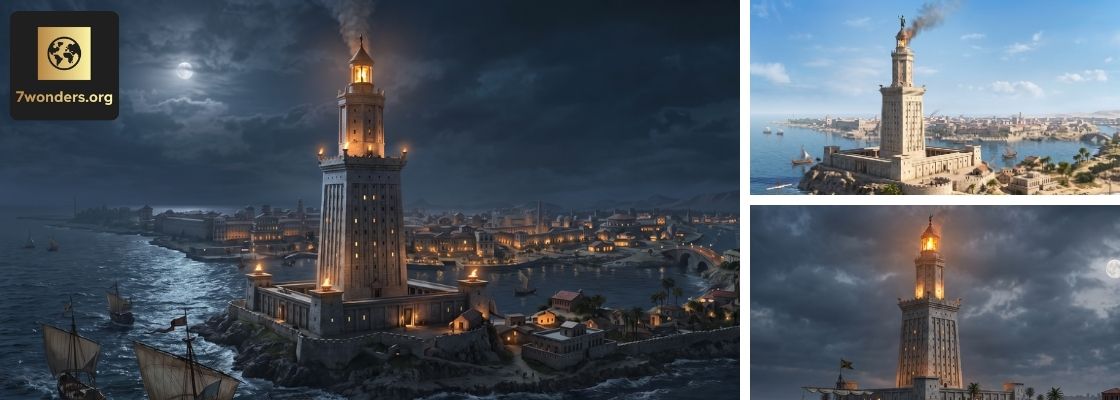
The Lighthouse of Alexandria was a giant stone lighthouse on the island of Pharos, at the entrance to the harbour of Alexandria, Egypt, built in the 3rd century BC.
The Lighthouse is one of the Seven Wonders of the Ancient World, and is also known as the Pharos of Alexandria. Pharos, the name of the island, later became a word for any lighthouse.
The Lighthouse of Alexandria stood at the eastern tip of the island of Pharos, in Alexandria, Egypt, on the spot where the Citadel of Qaitbay stands today.
Pharos was a long, narrow island lying close to the coast of Alexandria, according to Strabo, a Greek geographer who wrote around the start of the 1st century AD.
A causeway called the Heptastadion joined the island of Pharos to the mainland. Heptastadion is Greek for "seven stadia". A stadion was a Greek measure of length of about 185 m (607 ft).
The Heptastadion split the sea in front of Alexandria into two harbours, the royal Eastern Harbour and the Western Harbour.
Silt from the sea built up on both sides of the Heptastadion over the centuries. The silt turned the island of Pharos into a peninsula, which is part of the city of Alexandria today.
Alexandria is a port city on the Mediterranean coast of Egypt, about 220 km (137 mi) northwest of Cairo by road.
Alexandria is the second-largest city in Egypt and a major Mediterranean port.
Alexander the Great founded Alexandria in 332 BC. The city of Alexandria was the capital of Egypt until the Arab conquest in 642 AD, during the reign of the Ptolemaic kings who built the Lighthouse.
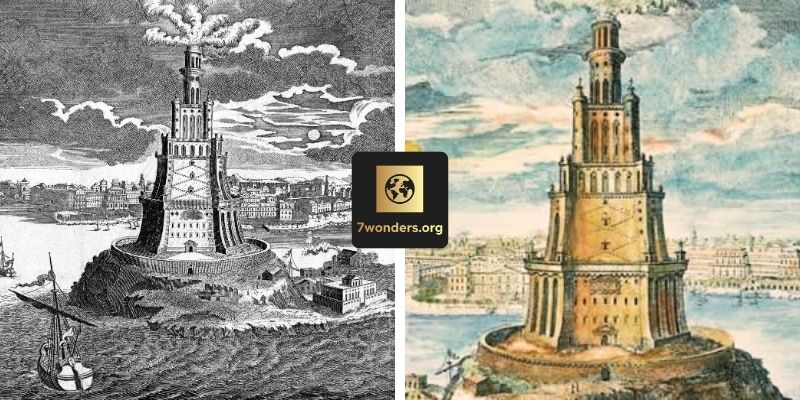
The history of the Lighthouse of Alexandria comes from Greek and Roman writers of the ancient world, and from Arab travellers who saw the Lighthouse in the Middle Ages.
Posidippus, a Greek poet at the court of the Ptolemaic kings, wrote a poem for the Lighthouse when the tower was new, in the 3rd century BC.
Strabo, Pliny the Elder, a Roman writer of the 1st century AD, and Josephus, a Jewish historian of the same century, all describe the Lighthouse in their works.
Arab geographers and travellers described the Lighthouse from the 10th century to the 14th century, when the tower fell into ruin. Al-Mas'udi wrote the fullest early account before 956 AD, according to the Centre d'Études Alexandrines, the French team that excavates the ruins of the Lighthouse.
The Lighthouse of Alexandria was built by Sostratus of Cnidus, a Greek from the city of Cnidus, in what is now Turkey, for the Ptolemaic kings of Egypt, Ptolemy I and Ptolemy II.
Ptolemy I, a general of Alexander the Great who became king of Egypt, began the Lighthouse. Ptolemy I died before the Lighthouse was finished, and his son Ptolemy II completed the tower.
Sostratus was "a friend of the kings", according to Strabo, who read the name of Sostratus in an inscription on the Lighthouse.
Sostratus was possibly the financial backer of the Lighthouse, according to the World History Encyclopedia.
King Ptolemy gave Sostratus permission to carve his own name on the Lighthouse, according to Pliny.
Sostratus carved his name into the stone and hid the name under plaster carrying the name of the king, in a story told by Lucian, a Greek writer of the 2nd century AD. In the story of Lucian, the plaster fell away over time. The words "Sostratus of Cnidos, the son of Dexiphanes, to the Divine Saviours" then appeared on the Lighthouse. The story is probably invented, according to Encyclopaedia Romana, a University of Chicago website on the ancient world.
The poem by Posidippus also names Sostratus as the builder, and speaks to "Lord Proteus". Proteus was the prophetic old man of the sea in Greek myth, a shape-changing god whose home was the island of Pharos in some versions of the myth, according to Britannica. In Homer's Odyssey, the Greek king Menelaus catches Proteus on Pharos to learn the way home from Troy.
The Lighthouse of Alexandria was built between about 297 and 281 BC, in the reigns of Ptolemy I and Ptolemy II.
The starting year of 297 BC comes from the Souda, a Greek encyclopedia written in the 10th century AD.
The Lighthouse was finished during the 124th Olympiad, between 283 and 281 BC, according to the Centre d'Études Alexandrines. An Olympiad was the four-year period between two Olympic Games, which the ancient Greeks used to count years.
The building of the Lighthouse took about 15 years. The Lighthouse was finished in about 280 BC, according to Britannica.
The Lighthouse of Alexandria was built to guide ships safely into the harbours of Alexandria, because the coast on either side of the city is low, with reefs and shallows.
Ships approaching Alexandria needed "some lofty and conspicuous sign" to find the entrance to the harbour, in the words of Strabo.
The inscription on the Lighthouse, as Strabo records it, dedicated the tower "for the safety of mariners".
Egypt does not have lookout posts on mountains, as the Greek islands do, according to the poem by Posidippus. The Lighthouse therefore rose from the low breakwater, visible "from countless stadia away", in the words of the poem.
Ptolemy I also meant the Lighthouse as a permanent reminder of his power, according to the World History Encyclopedia.
The Lighthouse of Alexandria looked like a tall tower of three tiers, square at the bottom, eight-sided in the middle and round at the top, with a statue on the summit, according to the Centre d'Études Alexandrines.
The Lighthouse was white, according to the World History Encyclopedia.
A stepped ramp on arches led up to a large door at the base of the Lighthouse.
Four tritons, sea gods with the body of a man and the tail of a fish, stood at the corners of the first terrace of the Lighthouse, blowing conch shells.
The statue on top of the Lighthouse was probably Zeus Soter, meaning Zeus the Saviour, according to Encyclopaedia Romana. The poem by Posidippus calls the Lighthouse a "saviour of Greeks". The inscription of Sostratus on the Lighthouse is dedicated "to the Divine Saviours".
The Lighthouse of Alexandria was made of limestone blocks, with a doorway framed in granite from Aswan, in southern Egypt, according to Michael Higgins, an emeritus professor at the Université du Québec à Chicoutimi, Canada.
Most blocks of the Lighthouse are shelly limestone, a stone full of fossil shells, and formed the core of the tower.
The granite lintels and uprights of the Lighthouse doorway weigh between 70 and 80 tons each.
Strabo described the Lighthouse as "admirably constructed of white marble with many stories".
The Lighthouse of Alexandria was between 100 m (330 ft) and 130 m (430 ft) tall, according to most modern estimates.
The Lighthouse was more than 110 m (361 ft) tall, according to Britannica. The tower stood more than 100 m (330 ft) high, in the figure given by the World History Encyclopedia.
Higher estimates for the Lighthouse reach about 132 m (435 ft), in Encyclopaedia Romana, and about 134 m (440 ft), in a second World History Encyclopedia article.
The estimates differ because the Arab writers who measured the Lighthouse used cubits and other units whose exact length is uncertain. A cubit is an ancient measure of length, from the elbow to the tip of the middle finger.
Yusuf ibn al-Shaykh, an Arab traveller from Spain, measured the Lighthouse in 1165 with a weighted cord. The measurement by Yusuf ibn al-Shaykh gives a height of 77 m (253 ft), according to Michael Higgins.
Repairs after earthquake damage in the 10th century had already made the Lighthouse about 21 m (70 ft) shorter by 1165, according to History Hit.
The Lighthouse of Alexandria worked by burning a fire at the top of the tower at night, so ships far out at sea saw the light and steered for the harbour.
The fire of the Lighthouse probably burned oil, because wood was scarce in Egypt, according to the World History Encyclopedia.
The flame of the Lighthouse was visible for 300 stadia, about 55 km (34 mi), according to Josephus.
The Lighthouse was visible from more than 70 miles (113 km) away, according to Ibn Jubayr, a Muslim pilgrim who passed through Alexandria in 1183.
Sailors risked mistaking the steady fire of the Lighthouse for a star, according to Pliny.
By day, the height of the Lighthouse made the tower itself the landmark. The Lighthouse appears "to cleave the sky from countless stadia away, during the day", in the words of the poem by Posidippus.
A mirror, probably of polished bronze, reflected the flame of the Lighthouse further out to sea, according to later Arab writers. In one legend, the mirror of the Lighthouse focused sunlight to set enemy ships on fire.
The exact place of the fire on the Lighthouse is uncertain. A fire at the top is hard to fit in the same space as the large statue, according to the Centre d'Études Alexandrines.
Yes, the Lighthouse of Alexandria was real, because writers who saw the Lighthouse described the tower for more than 1,500 years, and blocks from the tower lie on the seabed of Alexandria.
Julius Caesar, who fought in Alexandria in 48 BC, called the Lighthouse "of great height, a work of wonderful construction".
The Lighthouse of Alexandria was ruined by earthquakes. The earthquake of 8 August 1303 damaged the tower so badly that the Lighthouse was abandoned, according to the Centre d'Études Alexandrines.
The Lighthouse stood for almost 16 centuries, through 18 earthquakes and tsunamis, according to the Centre d'Études Alexandrines.
An earthquake in 796 AD damaged the Lighthouse, according to the World History Encyclopedia.
Ahmad ibn Tulun, the ruler of Egypt in the 9th century, built a wooden dome on top of the Lighthouse. The dome made the Lighthouse the highest mosque in the Muslim world. Later rulers of Egypt, including Sultan Baybars, rebuilt the fragile dome.
Earthquakes struck the Lighthouse again in 950 and 956 AD, and part of the tower collapsed in 956.
Repairs to the Lighthouse were planned in 1304, after the earthquake of 1303, but the work never took place. A further earthquake in 1323 damaged the tower again.
Ibn Battuta, a Moroccan traveller, found the first tier of the Lighthouse partly in ruins in 1326. By his second visit, in 1349, the Lighthouse was so ruined that the doorway was out of reach.
The Lighthouse collapsed between 1326 and 1349, according to Michael Higgins.
The Lighthouse had long fallen by 1477, when the Mamluk sultan Qaitbay ordered a fort built on the old foundations. The fort of Qaitbay remains on the site today.
What remains of the Lighthouse of Alexandria today is stone blocks and statues on the seabed of the Eastern Harbour, beside the Citadel of Qaitbay.
The ruins of the Lighthouse lie between 5 m (16 ft) and 10 m (33 ft) under the sea, according to the Centre d'Études Alexandrines.
Divers from the Centre d'Études Alexandrines had recorded 3,040 blocks on the seabed by January 2020. The blocks are granite, quartzite, diorite, marble and limestone, and include colossal statues weighing up to 40 tonnes (44 US tons), sphinxes and obelisks.
The ruins on the seabed are not all from the Lighthouse. Stones and statues were also thrown into the harbour in 1167, during the rule of Saladin, to block Crusader ships, according to the Egyptian Ministry of Tourism and Antiquities.
The blocks recovered from the Lighthouse make up less than 10% of the original building, according to the Centre d'Études Alexandrines.
Thirty-six pieces lifted from the sea in 1995 and 1996 are on show in the centre of Alexandria. The pieces stand in the open-air museum at the Roman Theatre of Kom el-Dikka and in front of the Bibliotheca Alexandrina, the modern library of Alexandria.
A colossal pink granite statue of a Ptolemaic king, dressed as a pharaoh, stands on the plaza of the Bibliotheca Alexandrina. The statue of the king was raised from the seabed beside the Citadel of Qaitbay in 1995 and 1996.
The underwater ruins of the Lighthouse of Alexandria were first explored in 1962, when Kamal Abu el-Saadat worked with the Egyptian Navy to raise a statue of the goddess Isis from the site.
A survey of the underwater ruins for UNESCO in 1968, by the British archaeologist Honor Frost, confirmed that parts of the Lighthouse lay on the seabed.
A barge crane later lowered about 3,600 tons of concrete blocks onto the ruins to strengthen the breakwater in front of the Citadel of Qaitbay. The concrete crushed many of the ancient stones.
Jean-Yves Empereur, a French archaeologist, began excavating the ruins in 1994. The Centre d'Études Alexandrines has dug on the site once or twice every year since 1994.
Twenty-two of the largest blocks of the Lighthouse were lifted from the seabed in May and June 2025. The 22 blocks include the lintels and uprights of the main doorway, the threshold, paving slabs from the foundations, and parts of a pylon, a monumental gateway in Egyptian style.
The pylon of the Lighthouse mixes Egyptian design with Greek building methods, according to the excavation team of Isabelle Hairy, an archaeologist at the French National Centre for Scientific Research (CNRS).
The Citadel of Qaitbay is a Mamluk fort built between 1477 and 1479 on the foundations of the Lighthouse of Alexandria, at the eastern tip of the Pharos peninsula.
Sultan Qaitbay wanted to see the site of the ancient Lighthouse, and ordered a tower built on the old foundations, according to the Centre d'Études Alexandrines. Stones from the ruins of the Lighthouse went into the walls of the Citadel.
The Citadel of Qaitbay is built of limestone and covers about 17,550 sq m (4.3 acres). A square keep of three floors, with half-round towers at the corners, stands at the centre of the Citadel.
A Mamluk mosque with a floor of small, cut stone mosaic survives inside the keep, which was rebuilt in 1939.
The Lighthouse of Taposiris Magna is a smaller copy of the Lighthouse of Alexandria, about 30 m (98 ft) tall, standing about 40 km (25 mi) west of Alexandria.
The tower at Taposiris Magna has the same three sections as the Lighthouse of Alexandria: square, eight-sided, and round, according to the Centre d'Études Alexandrines.
Taposiris Magna's lighthouse dates from the 2nd century BC, the century after the Lighthouse of Alexandria was finished.
The Lighthouse of Alexandria is one of the Seven Wonders because the Greek historian Diodorus Siculus included the Lighthouse in his list of the wonders in the 1st century BC. The list of Diodorus is now the accepted list of the Seven Wonders of the Ancient World.
Earlier lists of the Seven Wonders, by the Greek poet Antipater of Sidon and by Philo of Byzantium, left out the Lighthouse. Antipater and Philo named the walls of Babylon instead.
The first full modern version of the list of Seven Wonders appeared in Italy in 1608, according to the historians John and Elizabeth Romer.
Pharos means lighthouse in Greek. Pharos was first the name of the island off Alexandria. The Greek word pharos came to mean any lighthouse after the Lighthouse of Alexandria, according to the Online Etymology Dictionary.
The origin of the Greek word pharos is unknown.
English has used the word pharos for a lighthouse since the 1550s.
Pharos is still the root of the word for a lighthouse in many modern languages. The French word phare and the Italian and Spanish word faro both come from pharos.
Yes, real pictures of the Lighthouse of Alexandria survive on ancient Roman coins, but no photographs of the Lighthouse exist, because the tower fell in the 14th century.
About 1,000 bronze coins minted in Alexandria between 91 and 189 AD show the Lighthouse, under six Roman emperors from Domitian to Commodus, according to the Centre d'Études Alexandrines.
The coins of Alexandria show the ramp, the square lower tier with tritons blowing conch shells at the corners, the many-sided second tier and the standing statue on top of the Lighthouse.
A glass goblet found at Begram, near Kabul, in Afghanistan, also shows the Lighthouse. The Begram goblet dates from the late 1st or early 2nd century AD. Clay lamps in the shape of the Lighthouse survive too.
No, the Lighthouse of Alexandria was not the first lighthouse, because fire towers on the coasts of the Mediterranean guided sailors from the archaic period of Greece, between 800 and 480 BC, according to the Centre d'Études Alexandrines.
The Pharos became the model for later lighthouses. The Roman emperor Claudius built a very tall tower like the Pharos at Portus, the harbour of ancient Rome, to light ships at night, according to the Centre d'Études Alexandrines.
The Lighthouse of Alexandria has not been rebuilt, although plans for a replica on the site were put forward in 2015.
The 2015 plans to rebuild the Lighthouse went to the Supreme Council of Antiquities of Egypt and the governor of Alexandria, Hany el-Messiry, for approval. Little was made public about the design of the replica.
A digital copy of the Lighthouse is being built by the Pharos Project, begun in 2023 by the Centre d'Études Alexandrines and the Dassault Systèmes Foundation. The Pharos Project scans the blocks on the seabed and the blocks lifted in 2025 to make a 3D computer model of the Lighthouse, inside and out.
No, the Lighthouse of Alexandria job is not real, because the Lighthouse fell into ruin in the 14th century and does not have a light to keep.
Posts on social media since 2024 claim that the keeper of the Lighthouse earns USD 3.6 million a year, and that the job stays empty because of the isolation and rough seas.
The site of the Lighthouse is now a fort open to visitors, in the city of Alexandria.
No, the Lighthouse of Alexandria is gone, so the nearest you get to the Lighthouse is the Citadel of Qaitbay, which stands on the foundations of the Lighthouse.
Entry to the Citadel of Qaitbay costs EGP 200 (about USD 4) for foreign adults, paid by card only.
Dive centres in Alexandria take divers to the underwater ruins of the Lighthouse, at a depth of about 8 m (26 ft).
The Talgo train from Ramses Station in Cairo reaches Alexandria in about 2 hours 15 minutes. Borg El Arab Airport (HBE) is 47 km (29 mi) from Alexandria.
The UK Foreign Office does not advise against travel to Alexandria. The US State Department rates Egypt at Level 2, Exercise increased caution.