
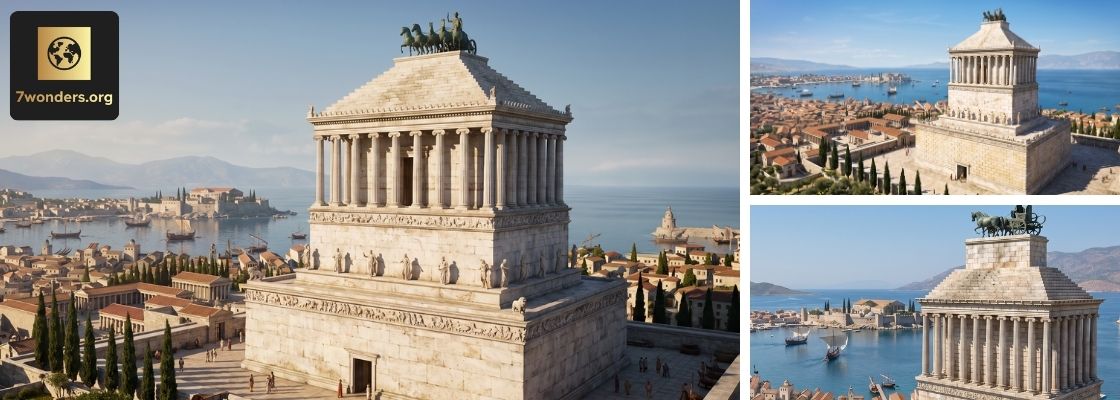
The Mausoleum at Halicarnassus was the monumental tomb of Mausolus, a ruler of Caria, built in the 4th century BC in the Carian capital, Halicarnassus, which is now the town of Bodrum in southwest Türkiye.
Mausolus' Mausoleum is one of the Seven Wonders of the Ancient World. The tomb of Mausolus was so famous that the name Mausoleum became the accepted word for any large and grand tomb.
The Mausoleum at Halicarnassus stood in the centre of the ancient city of Halicarnassus, now Bodrum, Turkey, on a site beside Turgutreis Caddesi, a street in the middle of the town.
Halicarnassus rose from its harbour in the shape of a theatre, according to Vitruvius, a Roman architect of the 1st century BC. The Mausoleum stood in a large square halfway up the slope, above the market place by the harbour.
The square around the Mausoleum was a terrace 105 m (344 ft) wide and 242 m (794 ft) long.
A tomb in the middle of a city was unusual in the ancient world, where burials almost always took place outside the city walls.
Halicarnassus is today the town of Bodrum, on the Aegean coast of southwest Turkey, in Muğla Province, opposite the Greek island of Kos.
Halicarnassus was a Greek city in Caria, an ancient region of southwest Asia Minor, which is the Asian part of modern Turkey. Dorian Greeks from the city of Troezen, in southern Greece, founded Halicarnassus.
The modern town of Bodrum covers the ancient city. Parts of the city wall of Halicarnassus, a gymnasium, a temple platform and tombs cut into the rock survive in Bodrum.
The Greek historian Herodotus was born in Halicarnassus around 484 BC, about 130 years before the Mausoleum was built.
The history of the Mausoleum at Halicarnassus comes from Greek and Roman writers, from accounts of the knights who took the Mausoleum apart, and from the sculpture found on the site.
Pliny the Elder, a Roman writer of the 1st century AD, gave the fullest ancient description of the Mausoleum, with the size of the tomb, the number of columns and the names of the sculptors.
Aulus Gellius, a Roman writer of the 2nd century AD, told the story of Artemisia, the wife of Mausolus, and her grief after the death of Mausolus.
Claude Guichard, a French writer, recorded in 1581 what the Knights of St John found inside the Mausoleum in 1522, while the knights were pulling the building down.
Mausolus, also written Maussollos, was the ruler of Caria from about 377 to 353 BC, as a satrap, or governor, for the king of Persia, although Mausolus ruled Caria almost as an independent king.
Mausolus moved the capital of Caria from Mylasa, inland, to Halicarnassus on the coast.
Halicarnassus gained a great city wall, public buildings, and a secret dockyard and canal under Mausolus, around 370 BC.
In 362 BC, Mausolus joined a revolt of the satraps of Asia Minor against the Persian king Artaxerxes II.
Mausolus married his sister, Artemisia II. Artemisia ruled Caria alone for about three years after the death of Mausolus.
The Mausoleum at Halicarnassus was built by Artemisia II, the sister and widow of Mausolus, who directed the work on the tomb after the death of Mausolus.
Mausolus began planning his tomb himself, before his death.
The Greek architects Pythius, also written Pytheos, and Satyros designed the Mausoleum.
Four of the leading Greek sculptors of the time each carved one side of the Mausoleum, according to Pliny. Scopas carved the east side, Bryaxis the north, Timotheus the south and Leochares the west.
A fifth sculptor, Pythis, made the marble chariot group at the peak of the Mausoleum.
Artemisia died before the Mausoleum was finished. The four sculptors stayed on and finished the tomb, because the sculptors saw the Mausoleum as "a memorial to their own glory and that of their profession", in the words of Pliny.
The Mausoleum at Halicarnassus was built between about 353 and 351 BC, after the death of Mausolus, according to Britannica.
Work on the Mausoleum began possibly as early as 367 BC, while Mausolus was alive, according to the World History Encyclopedia.
The Mausoleum dates to about 350 BC, according to the British Museum, which displays sculpture from the tomb in London.
The Mausoleum at Halicarnassus was built as the tomb of Mausolus, to keep the memory of the ruler of Caria alive after his death.
The sculptures on the Mausoleum showed life at the court of Mausolus and the hopes of Mausolus for the afterlife, according to the British Museum.
Artemisia built the Mausoleum out of grief for her husband, according to Aulus Gellius. In the story told by Gellius, Artemisia mixed the bones and ashes of Mausolus with spices, ground the mixture into a powder, and drank the powder in water.
Artemisia also held a contest of speeches in praise of Mausolus, with large prizes of money, when the Mausoleum was dedicated. The Greek historian Theopompus won the contest, according to Gellius.
The Mausoleum at Halicarnassus looked like a ring of columns on a tall podium, with a stepped pyramid for a roof and a marble chariot on top.
The ring of columns around the Mausoleum had 36 columns, according to Pliny.
The pyramid on the Mausoleum rose in 24 steps and was as tall as the building below the pyramid.
The chariot at the peak of the pyramid had a team of four marble horses. The chariot carried statues of Mausolus and Artemisia, according to the Turkish Ministry of Culture and Tourism.
Friezes, long bands of carved marble, ran around the Mausoleum. The friezes showed Greeks fighting Amazons, the women warriors of Greek myth, and Greeks fighting centaurs. A third frieze showed a chariot race.
Statues of people, lions and horsemen stood around the Mausoleum, carved at three different sizes and painted in bright colours.
The fragments found at the Mausoleum come from 66 different statues. The Mausoleum carried at least 100 statues when complete, by the estimate of historians.
The Mausoleum at Halicarnassus was between 40 m (131 ft) and 45 m (148 ft) tall, according to most modern estimates.
The height of the Mausoleum to the top of the chariot was "140 feet", in the words of Pliny, measured in Roman feet.
The Mausoleum was about 40 m (131 ft) tall, according to the British Museum. Other estimates put the height of the Mausoleum at about 42 m (138 ft), in a 2026 book published by Cambridge University Press, and about 45 m (148 ft), in the World History Encyclopedia.
The highest figure for the Mausoleum, about 50 m (164 ft), comes from the Turkish Ministry of Culture and Tourism.
The Mausoleum at Halicarnassus was made of marble from Anatolia, now Turkey, and from Mount Pentelicus, near Athens, according to the World History Encyclopedia.
The statues of the Mausoleum were carved from marble of more than one kind. The colossal male statue in the British Museum known as "Mausolus" has a body of Pentelic marble and a head of Parian marble, from the Greek island of Paros.
The marble horses of the chariot on the Mausoleum wore bridles and bits of bronze. Metal reins, set into drilled holes, hung from the horses on the frieze of Greeks and Amazons.
The inside of the Mausoleum at Halicarnassus held the burial chamber of Mausolus, below ground level under the tomb.
Knights of St John broke into the base of the Mausoleum in 1522, according to Claude Guichard. The knights found a large square hall decorated with marble columns and carved reliefs of battle scenes.
Beyond a low doorway, the knights found a coffin of white marble, in the account of Guichard. The knights returned to the burial chamber the next day and found the coffin open, with scraps of gold cloth and gold spangles scattered on the ground. Guichard blamed pirates for the robbery.
The burial chamber of the Mausoleum had been robbed long before the knights arrived, according to Danish archaeologists who excavated the Mausoleum in the 1960s. The robbers reached the burial chamber through a tunnel dug under the tomb.
The Mausoleum at Halicarnassus collapsed in an earthquake in 1304 AD, according to the Turkish Ministry of Culture and Tourism. The Knights of St John later took the ruins of the Mausoleum apart for stone.
An earthquake destroyed the Mausoleum at some time between the 11th and the 15th century, according to Britannica.
In the 12th century, the Greek scholar Eustathius wrote that the Mausoleum "was and is a wonder", so the tomb still stood at that time.
The Knights of St John, a crusading order of knights then based on the island of Rhodes, took over the site of Halicarnassus in 1402. Stone from the ruins of the Mausoleum went into a castle that the knights built by the harbour.
More stone from the Mausoleum went into new defences for the castle in 1494.
In 1522, the knights expected an attack by the Ottoman Turks and pulled down almost all of the Mausoleum that still stood. Much of the marble of the Mausoleum was burned to make lime for mortar. The Ottoman sultan Süleyman the Magnificent took Bodrum from the knights later in 1522.
Almost nothing of the Mausoleum remained above ground after 1522.

Only the foundations and scattered fragments of the Mausoleum at Halicarnassus remain today, on the original site in Bodrum.
The foundations of the Mausoleum sit in a large pit cut into the rock. The burial chamber of Mausolus lies below ground level at the bottom of the pit, with a stairway and an ancient drainage channel beside the burial chamber.
The fragments on the site of the Mausoleum include pieces of columns, friezes and walls. A small exhibition hall on the site shows models of the Mausoleum, copies of the Amazon frieze and original fragments found on the site.
Charles Newton, a British archaeologist, dug at Bodrum for the British Museum in 1856 and 1857. Newton found the site of the Mausoleum in January 1857, using the description of Pliny as a guide.
Kristian Jeppesen of Aarhus University in Denmark led the full excavation of the Mausoleum from 1966 to 1977. The site of the Mausoleum opened as a museum in 1982.
Bodrum Castle, also called the Castle of St Peter, is the fortress by the harbour of Bodrum that the Knights of St John began building in 1404.
Marble columns and carved reliefs from the Mausoleum are visible in the walls of Bodrum Castle today.
The knights set more sculpture from the Mausoleum into the walls of the castle between 1505 and 1507. The sculpture set into the castle walls included 12 slabs of the Amazon frieze.
Bodrum Castle has housed the Museum of Underwater Archaeology since 1962. The Museum of Underwater Archaeology displays finds from shipwrecks, from the Bronze Age to the Ottoman period.
Sculpture from the Mausoleum at Halicarnassus is on display in Room 21 of the British Museum in London.
The slabs of the Amazon frieze from Bodrum Castle were a gift to the British Museum in 1846 from the Ottoman sultan Abdülmecid I. Stratford Canning, the British ambassador to the Ottoman Empire, arranged the removal of the Amazon frieze from the castle walls.
The finds from the excavations of Charles Newton reached the British Museum in 1857. The finds of Newton include more slabs of the Amazon frieze, parts of the stepped pyramid roof, and the front half of a marble horse from the chariot on top of the Mausoleum. The marble horse stands 2.33 m (7.6 ft) tall.
Two colossal marble statues of a man and a woman from the Mausoleum, each about 3 m (10 ft) tall, are known as "Mausolus" and "Artemisia". The two statues probably show members of the Hecatomnids, the ruling family of Caria. The statues from the Mausoleum are not known to show Mausolus and Artemisia themselves, according to the British Museum.
The word mausoleum comes from Mausolus, through the Latin word mausoleum and the Greek word Mausoleion, the name of the tomb of Mausolus at Halicarnassus.
English took the word mausoleum from Latin in the early 15th century, as the name of the tomb at Halicarnassus. By about 1600, mausoleum meant any grand tomb.
Mausoleum is pronounced maw-suh-LEE-um or maw-zuh-LEE-um.
The Mausoleum at Halicarnassus is one of the Seven Wonders because Greek and Roman writers ranked the tomb of Mausolus among the greatest sights of the ancient world, especially for its sculpture.
Antipater of Sidon, a Greek poet of the 2nd century BC, named "the vast tomb of Mausolus" in a poem listing the wonders of the world.
The four sculptors of the Mausoleum made the tomb one of the seven wonders, according to Pliny. Aulus Gellius also counted the Mausoleum among the Seven Wonders of the Ancient World.
No, there aren't any real pictures of the Mausoleum at Halicarnassus, because the pictures made while the tomb stood have not survived.
Every image of the Mausoleum is a reconstruction, based on the description of Pliny and on the fragments found at Bodrum.
An early reconstruction of the Mausoleum is a 1572 engraving by Philips Galle, after a design by the Dutch artist Maarten van Heemskerck, in a series on the wonders of the world.
A model of the Mausoleum, made between about 1800 and 1834, is in Sir John Soane's Museum in London.
The Mausoleum at Halicarnassus inspired the following buildings.
Yes, you can visit the site of the Mausoleum at Halicarnassus in the centre of Bodrum, where the foundations of the tomb form an open-air museum.
The Mausoleum site is open from 08:30 to 17:30 and is closed on Mondays.
Entry to the Mausoleum site costs 70 Turkish lira, according to travel guides. The Müzekart, the museum pass of the Turkish Ministry of Culture and Tourism, covers entry to the Mausoleum site.