
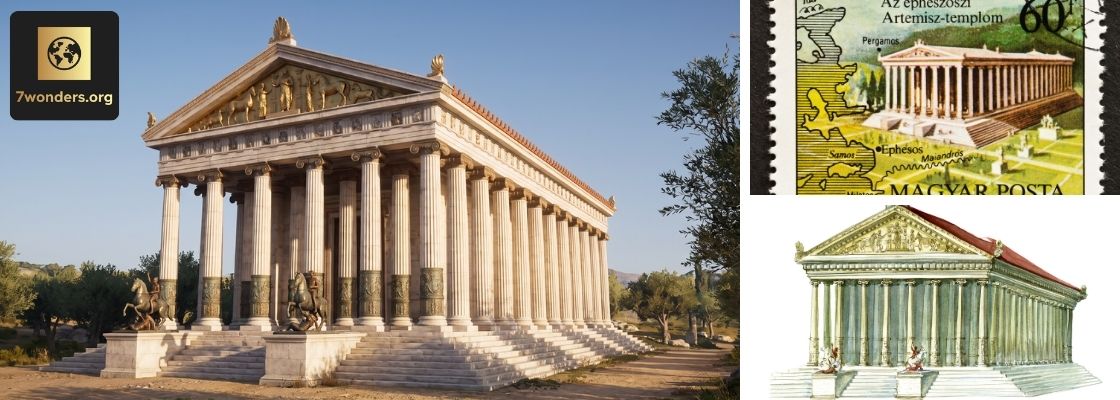
The Temple of Artemis, also called the Artemision, was a marble temple to the Greek goddess Artemis in the ancient city of Ephesus, near the town of Selçuk in western Türkiye.
The Artemision is one of the Seven Wonders of the Ancient World. The temple at Ephesus drew pilgrims from all around the Mediterranean, according to UNESCO.
The Temple of Artemis stood on the edge of the modern town of Selçuk, in İzmir Province, western Turkey, about 55 km (34 mi) south of the city of İzmir in a straight line.
The site of the Artemision lies about 100 m (330 ft) from Selçuk bus station, beside the road from Selçuk to the ruins of Ephesus.
The İsa Bey Mosque stands between the temple site and the Basilica of St John, at the foot of Ayasuluk Hill.
The Temple of Artemis was built on marshy ground, so that earthquakes would not damage the temple, according to Pliny the Elder, a Roman writer of the 1st century AD.
Ephesus is today an archaeological site about 3 km (2 mi) from Selçuk.
In the 4th century BC, Lysimachos, one of the generals of Alexander the Great, founded a new city of Ephesus and left the old city around the Temple of Artemis.
The ruins of Ephesus seen by visitors today are mostly buildings of the Roman city, such as the Library of Celsus and the Temple of Hadrian.
Ephesus has been a UNESCO World Heritage Site since 2015.
The UNESCO listing of Ephesus describes the sanctuary of Artemis as one of the largest and most powerful sanctuaries of the ancient world.
The history of the Temple of Artemis comes from Greek and Roman writers and from excavations on the temple site since 1869.
Herodotus, a Greek historian of the 5th century BC, recorded the gifts of King Croesus to the Temple of Artemis.
Vitruvius, a Roman architect of the 1st century BC, named the architects of the temple and described the machines they used.
Strabo, a Greek geographer who wrote around the start of the 1st century AD, told the story of the burning and the rebuilding of the temple.
The Temple of Artemis was built by King Croesus of Lydia, who gave the temple golden cows and most of its columns, according to Herodotus. Lydia was an ancient kingdom of western Asia Minor, with its capital at Sardis.
Four fragments of the temple's columns in the British Museum carry parts of an inscription reading "King Croesus dedicated this". The Croesus fragments are not on display.
The architects of the Artemision were Chersiphron of Knossos, in Crete, and his son Metagenes, according to Vitruvius. Demetrius, a priest of the temple, and Paeonius of Ephesus completed the building.
The later Temple of Artemis, rebuilt in the 4th century BC, was the work of the architect Cheirocrates, according to Strabo.
A Greek legend credited the Amazons, the women warriors of Greek myth, with founding the temple at Ephesus. Jordanes, a historian of the Goths, still calls the Temple of Artemis the temple "which, as we said before, the Amazons built".
The Temple of Artemis was built in about 550 BC, in the reign of King Croesus.
Work on the marble temple began as early as 570 BC, by other estimates. The building of the Artemision took 120 years, according to Pliny.
Excavations have found traces of three smaller, older temples under the temple of Croesus.
The earliest known temple building at Ephesus dates from about 660 to 640 BC, according to the Austrian Archaeological Institute. The oldest finds from the sanctuary of Artemis date from the Late Bronze Age.
The Temple of Artemis was built as the house of the goddess Artemis of Ephesus.
Artemis was the Greek goddess of wild animals, the hunt, vegetation and childbirth.
Artemis of Ephesus was originally an Anatolian mother goddess, according to UNESCO. Anatolia is the Asian part of modern Turkey.
The Temple of Artemis was also a place of refuge, or asylum, according to Strabo. Alexander the Great extended the limits of the refuge to one stadium, a Greek measure of length, around the temple.
The Roman general Mark Antony doubled the limits of the refuge and took in part of the city. The larger refuge put Ephesus in the power of criminals, so the emperor Augustus cancelled the extension.
The priests of the Artemision were eunuchs, called Megabyzi, according to Strabo.
The Temple of Artemis looked like a long marble temple surrounded by two rows of tall Ionic columns, with the shrine of the goddess in the middle, according to Vitruvius.
The carved columns of the Artemision had figures carved in relief. One carved column was the work of the Greek sculptor Scopas, according to Pliny.
The temple at Ephesus was one of only four places with temples decorated in marble, according to Vitruvius.
A staircase made from the trunk of a single vine led up to the roof of the Artemision, according to Pliny.
The inside of the Temple of Artemis held the statue of Artemis of Ephesus, a stiff, upright figure of the goddess with her hands held out and a tall headdress on her head.
The statue of Artemis at Ephesus "fell from heaven", in the words of the town clerk of Ephesus in the Acts of the Apostles, a book of the Bible.
Statues of Amazons by the most famous Greek sculptors stood in the Temple of Artemis, according to Pliny. The sculptors chose the best Amazon statue by their own vote. Each sculptor voted his own Amazon the best.
The Amazon by Polykleitos won the contest, because every sculptor ranked the Amazon by Polykleitos second after his own. The Amazon by Pheidias came second, and the Amazon by Cresilas third.
The altar of the Artemision was filled with works by the sculptor Praxiteles, according to Strabo.
The Temple of Artemis was the largest building in the Greek world, at about 115 m (378 ft) long and 55 m (181 ft) wide on its stone base.
The temple at Ephesus covered about three times the area of the Parthenon in Athens, which measures 69.5 m (228 ft) by 30.88 m (101 ft).
The Temple of Artemis was "425 feet" long and "225 feet" wide, in the words of Pliny. The temple measured about 110 m (361 ft) by 55 m (181 ft), according to Britannica.
The columns of the first marble temple were 19 m (62 ft) high, by one estimate. The columns of the rebuilt temple were slightly lower, at 17.65 m (58 ft). The columns were "60 feet" high, in the words of Pliny.
The exact height of the columns of the Artemision is unknown, because the surviving pieces of the columns are too broken to measure.
The Temple of Artemis was made of marble. The temple of Croesus was the first marble temple on the site.
The oldest temple on the site, which is no longer visible, had stone walls and wooden columns.
The foundations of the Artemision were laid over a layer of trodden charcoal and a layer of sheepskins with the wool left on, according to Pliny.
The Temple of Artemis was built with marble column shafts and beams rolled from the quarries by teams of oxen, according to Vitruvius. The quarries lay no more than "eight thousand feet" from the temple.
Chersiphron fixed pivots into each end of a column shaft and set the pivots into a wooden frame. When the oxen pulled the frame, the column shaft rolled along the ground like a roller.
Metagenes fitted wheels about "twelve feet" across to the ends of the long stone beams that sat on top of the columns.
The stone beams of the Artemision were raised onto the columns up a ramp of sandbags, according to Pliny. The lowest bags were then emptied, so that the beams sank slowly into place.
In the story told by Pliny, the largest block of the temple, the lintel over the door, would not settle into place. Chersiphron dreamed that Artemis told him she had laid the stone herself. The next morning, the lintel had settled into place under its own weight.
The Temple of Artemis was burned down by Herostratus, who set fire to the temple to become famous.
Herostratus burned the temple so that the destruction of such a beautiful building would spread his name through the whole world, according to Valerius Maximus, a Roman writer.
The people of Ephesus passed a decree to wipe out the memory of Herostratus. The Greek historian Theopompus recorded the name of Herostratus anyway.
Alexander the Great was born on the same day that the Temple of Artemis burned, according to Plutarch, a Greek biographer. The Greek writer Hegesias joked that the temple burned because Artemis was away, helping at the birth of Alexander.
The date of 21 July 356 BC, often given for the fire, is a modern conversion of the Greek date of Alexander's birth in Plutarch, the sixth day of the month of Hecatombaeon.
Yes, the Temple of Artemis was rebuilt by the people of Ephesus after the fire, according to Strabo.
The people of Ephesus paid for the new temple with the jewellery of the women of the city and with their own belongings. The Ephesians also sold the columns of the burned temple.
Alexander the Great proposed to pay the whole cost of the new temple at Ephesus, if his name went on the inscription of the temple. The Ephesians refused. One Ephesian told Alexander that it was not fitting for a god to dedicate offerings to other gods.
The rebuilt Temple of Artemis was ready by 323 BC. The new temple stood on a stepped base 2.70 m (8.9 ft) higher than the floor of the temple of Croesus.
The Temple of Artemis was destroyed by the Goths in 262 AD and was not rebuilt, according to Britannica.
The Goths crossed the Hellespont, the strait between Europe and Asia now called the Dardanelles, and set fire to "the renowned temple of Diana at Ephesus", according to Jordanes.
The Temple of Artemis was only plundered by the Goths, around 267 AD, in another account. A Christian mob destroyed the temple for good in 401 AD, in the same account.
The Roman emperor Theodosius I ordered the pagan temples of the Roman Empire closed in the 390s AD. The Temple of Artemis was probably already in ruins by that time.
A sermon credited to Cyril of Alexandria, a bishop in Egypt, calls John Chrysostom, the archbishop of Constantinople, the "overthrower of the temple of Diana". The sermon is not thought to be the work of Cyril.
The Acts of John, an early Christian story left out of the Bible, claims that the altar of Artemis broke into pieces and half of the temple fell down when the apostle John prayed in the temple.
Columns in the Hagia Sophia, in Istanbul, are often said to come from the Temple of Artemis. The story is a medieval tradition, which the Byzantine specialist Cyril Mango called absurd.
Pieces of the Artemision went into the Basilica of St John on Ayasuluk Hill. Blocks from the temple were reused in many other buildings at Ephesus, so little remains of the Temple of Artemis today.
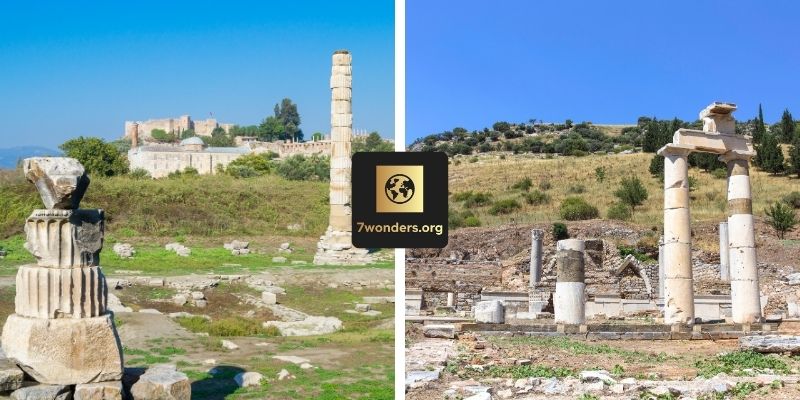
One re-erected column and the foundations of the Temple of Artemis remain today, on the original site at Selçuk.
The column at the temple site was put together in 1973 from drums of several different columns. The re-erected column stands on an original base from the rebuilt temple of the 4th century BC. The original columns of the Artemision were about 4 m (13 ft) taller than the re-erected column.
Storks nest on top of the re-erected column from April into September.
The foundations of the temple at Ephesus lie below the water table, in a pit that is often flooded. The pit is the hole left by the excavations of John Turtle Wood, who found the pavement of the temple in 1869, 20 feet (6 m) below the marshy ground, after a six-year search paid for by the British Museum.
David Hogarth dug under the Temple of Artemis for the British Museum in 1904 and 1905. Hogarth found 93 coins of electrum, a natural mix of gold and silver, left as offerings in the late 7th century BC. The coins from the Artemision are among the oldest coins in the world.
The Austrian Archaeological Institute excavated the temple site from 1965 to 1995. Finds from earlier Austrian work at the temple, including an Amazon from the altar, are in the Ephesos Museum in Vienna.
Most of the surviving architectural pieces of the Temple of Artemis are in the British Museum in London.
A carved column drum from the rebuilt temple at Ephesus, made between 340 and 320 BC, is on display in Room 22 of the British Museum. Wood found the column drum at the southwest corner of the temple.
The column drum is 1.82 m (6 ft) high. The carvings on the drum show a draped woman, perhaps Alcestis or Eurydice, between Thanatos, the Greek god of death, and Hermes, the guide of souls to the underworld.
Two marble statues of Artemis of Ephesus stand in the Ephesus Museum in Selçuk, in the Hall of Artemis Ephesia.
The two Artemis statues were found in the Prytaneion, the town hall of the Roman city of Ephesus. The Artemis statues date from the 1st and 2nd centuries AD.
The statues of Artemis of Ephesus have rows of egg-shaped forms across the upper body. The egg-shaped forms have been read as breasts, eggs, grapes or nuts. In one theory, by the scholar Seiterle, the forms are the scrotums of bulls, hung on the statue of the goddess at sacrifices.
The belt of one Artemis statue is carved with bees, the symbol of Ephesus.
The Ephesus Museum also has a Hall of Artemis Temple Findings, with other objects from the Temple of Artemis.
The Temple of Artemis is also called the Temple of Diana because Diana is the Roman name for Artemis.
The Romans identified Diana, their goddess of wild animals and the hunt, with the Greek goddess Artemis. Latin writers such as Pliny and Vitruvius call the temple at Ephesus the temple of Diana.
Yes, the Temple of Artemis appears in the Bible, in chapter 19 of the Acts of the Apostles.
In the Acts of the Apostles, Demetrius, a silversmith of Ephesus, made silver shrines of Artemis for sale. Demetrius stirred up a riot against the apostle Paul, warning that the preaching of Paul would bring the temple of the great goddess Artemis into disrepute.
The crowd of Ephesus shouted "Great is Diana of the Ephesians" for about two hours, in the words of the King James Version.
The Temple of Artemis is one of the Seven Wonders of the Ancient World because Greek writers ranked the temple at Ephesus as the greatest sight of the known world.
Antipater of Sidon, a Greek poet of the 2nd century BC, listed the wonders in a poem and placed the house of Artemis above all the others. "Lo, apart from Olympus, the Sun never looked on aught so grand," wrote Antipater.
Philo of Byzantium wrote that anyone who saw the Temple of Artemis would believe "the heavenly world of the immortals has changed places with the earth".
No, there aren't any real pictures of the Temple of Artemis, because the pictures made while the temple stood have not survived.
Every image of the Artemision is a reconstruction, based on the descriptions by Pliny and Vitruvius and on the pieces found at Ephesus.
An early reconstruction of the temple at Ephesus is a 1572 engraving by Philips Galle, after a design by the Dutch artist Maarten van Heemskerck. The engraving is in the National Gallery of Art in Washington, DC.
Yes, you can visit the site of the Temple of Artemis, on the edge of Selçuk, every day of the week.
Entry to the site of the Artemision is free, according to travel guides.
The ruins of Ephesus are about a 30-minute walk from Selçuk, so you can see the temple site and the ancient city of Ephesus on the same day.
Yes, other temples of Artemis stood across the ancient Greek world, but the temple at Ephesus was the most famous. The following temples of Artemis are also well known.