
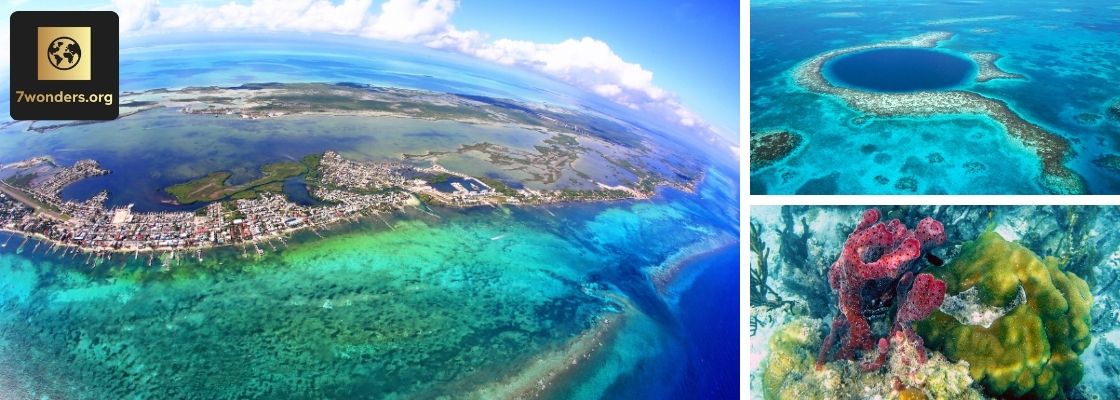
The Belize Barrier Reef is a coral reef that runs along the Caribbean coast of Belize, in Central America.
Belize's barrier reef is the second-largest reef system in the world after the Great Barrier Reef of Australia, and is one of the Seven Underwater Wonders of the World. The best-known sight on the reef is the Great Blue Hole, a deep, round sinkhole in the middle of Lighthouse Reef atoll.
The Belize Barrier Reef is in the Caribbean Sea, off the coast of Belize in Central America, and runs from the border with Mexico in the north to near the border with Guatemala in the south.
Belize's barrier reef lies about 300 m (984 ft) offshore in the north and 40 km (25 mi) offshore in the south. At Rocky Point, the reef touches the shore.
Three atolls, rings of reef around a shallow lagoon, lie further out to sea beyond the barrier reef. The three atolls are Turneffe, Lighthouse Reef and Glover's Reef.
Belize City is the nearest city to the reef.
Snorkel and dive trips to Belize's barrier reef start from Ambergris Caye, Caye Caulker and the Placencia peninsula. A caye is a small, low island of sand or mangroves.
To get to the Belize Barrier Reef, travel to one of the island or coastal towns where reef trips start, using the following routes.
To get from Belize City to Caye Caulker or San Pedro, take a San Pedro Belize Express water taxi from Belize City, or fly to San Pedro with Tropic Air or Maya Island Air.
The flight from Belize City Airport to San Pedro covers 55 km (34 mi) and takes 13 minutes.
Caye Caulker lies about 1.6 km (1 mi) from the Belize Barrier Reef.
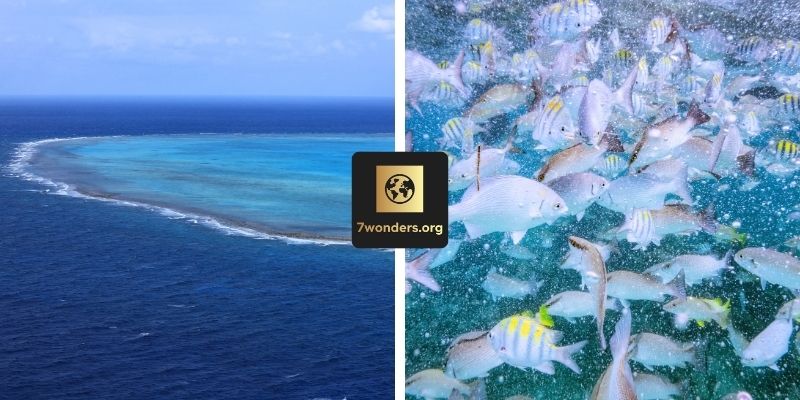
The Belize Barrier Reef is a barrier reef, a line of coral reef that runs parallel to the coast with a lagoon between the reef and the shore.
The lagoon behind Belize's barrier reef is 2 m (7 ft) to 3 m (10 ft) deep in the north. South of Belize City, the lagoon deepens into a channel 65 m (213 ft) deep.
The Maya fished and traded along the Belize reef from about 300 BC to 900 AD. In the 17th century, pirates of Scottish and English descent sheltered at the reef.
Charles Darwin called the Belize Barrier Reef "the most remarkable reef in the West Indies" in his 1842 book, The Structure and Distribution of Coral Reefs.
The Belize Barrier Reef formed as corals grew on top of an older, dead reef after the sea flooded the coast of Belize at the end of the last ice age.
The older reef under Belize's barrier reef is limestone, laid down by corals in the last warm period between ice ages. During the last ice age, the sea level fell. The old limestone reef then lay above the water as dry land.
As the ice melted, the sea rose again, and new corals settled on the drowned limestone. Drill cores from the reef show that the living reef started to grow at different times along the coast, because the old limestone surface sits higher in some places than others (Gischler and Hudson, 2004).
Belize's barrier reef has grown upwards by about 3 m (10 ft) every 1,000 years. The living reef is between 4.8 m (16 ft) and at least 21 m (69 ft) thick in the drill cores.
Elkhorn coral and star corals have been the most common reef-building corals on the Belize Barrier Reef for the last 9,000 years (Gischler et al., 2023).
The Great Blue Hole, also called the Blue Hole, a round sinkhole near the middle of Lighthouse Reef, was formed when the roof of a limestone cave collapsed during the last ice age.
Lighthouse Reef was a limestone island during the last ice age, when sea levels were much lower. The cave under the island was a karst cave, a cave hollowed out of limestone by rainwater.
As the ice sheets melted, the sea rose and flooded Lighthouse Reef about 7,200 years ago (Goethe University Frankfurt, 2025). The flooded cave became the Blue Hole.
Stalactites hang from ledges inside the Blue Hole. Stalactites grow only from water dripping in air, so the stalactites show that the Blue Hole was once a dry cave. Some stalactites hang up to 12 degrees off vertical because movements of the earth's crust have tilted the rock since the stalactites grew.
The Belize Barrier Reef is still alive, but it is in poor health after coral bleaching and disease killed corals across the wider Mesoamerican Reef in 2023 and 2024.
The Mesoamerican Reef is the larger reef system that includes the Belize Barrier Reef. The 2023 bleaching was the worst on record on the Mesoamerican Reef, with about 40% of its corals badly bleached.
Coral bleaching turns corals white when warm water makes them lose the algae that live inside them. Bleached corals often die if the algae do not return within a few months.
Live coral covered 17% of the Mesoamerican Reef in 2024, down from 19% in the previous survey. Of the 286 Mesoamerican Reef sites surveyed for the 2024 report, 39% were in poor condition and 23% in critical condition.
Fish are recovering on the Mesoamerican Reef. The number of fish of the kinds caught for food rose by 40% in the 2024 survey, mainly because fishing rules were enforced more strictly (Healthy Reefs Initiative, 2024).
Elkhorn coral, once a main reef builder, declined along the Belize Barrier Reef in the second half of the 20th century. High sea temperatures and Hurricane Mitch, a category 5 storm in 1998, further reduced elkhorn coral.
Storms now pass over the Belize Barrier Reef more often. Layers of coarse sand in the mud of the Great Blue Hole record between 4 and 16 tropical storms and hurricanes a century over the last 6,000 years, and 9 in the last 20 years alone (Goethe University Frankfurt, 2025).
The Belize Barrier Reef is protected by seven marine reserves, national parks, and natural monuments along the reef and its atolls, listed together as a UNESCO World Heritage Site.
Together, the seven areas form the Belize Barrier Reef Reserve System, made up of the following protected areas, with the year each was established.
The seven protected areas cover 12% of the Belize reef system. Each protected area has its own official management plan. The Government of Belize and conservation charities jointly run the protected areas.
The Belize Barrier Reef Reserve System went on UNESCO's List of World Heritage in Danger in 2009, because of the destruction of mangroves and marine habitats, offshore oil extraction and unsustainable building projects.
The Government of Belize then banned oil exploration in all of Belize's offshore waters. The reserve system came off the danger list in 2018, after the oil ban and stronger protection for mangroves.
Part of Belize's barrier reef off Ambergris Caye is protected as Hol Chan Marine Reserve, outside the World Heritage Site.

The Belize Barrier Reef includes many reef types in a small area, including fringing reefs along the shore, patch reefs in the lagoon, the barrier reef itself, and atolls in the open sea.
The range of reef types packed into one small area is one reason UNESCO listed Belize's reef as a World Heritage Site.
The Great Blue Hole is a round, deep blue sinkhole about 300 m (984 ft) across, ringed by coral reef, in the shallow water of Lighthouse Reef atoll.
Lighthouse Reef lies about 80 km (50 mi) off Belize's coast. From above, the Blue Hole looks like a dark blue eye in the atoll's pale water because the seabed drops away steeply at the edge of the hole.
Jacques Cousteau, the French ocean explorer, made the Great Blue Hole famous in the 1970s. Divers and snorkelers have visited the Blue Hole ever since.
The Great Blue Hole is the center of the Blue Hole Natural Monument. Great hammerhead sharks are among the Blue Hole's top predators.
The Great Blue Hole is about 125 m (410 ft) deep, measured from the surface to the mud on the hole floor.
A layer of water full of dissolved hydrogen sulfide, a poisonous gas, covers the whole of the Blue Hole at a depth of about 88 m (290 ft), according to a submarine expedition in 2018. The water below the hydrogen sulfide layer does not contain oxygen. Sea life in the Blue Hole does not swim down through the hydrogen sulfide layer.
The hydrogen sulfide layer blocks light from above, leaving the bottom of the Great Blue Hole in darkness.
Hol Chan Marine Reserve is Belize's oldest marine reserve, set up in 1987 at the southern tip of Ambergris Caye, about 15 minutes by boat from San Pedro.
Hol Chan means "little channel" in Maya, after the cut through the barrier reef at the center of the reserve. Fish, sea turtles, moray eels and eagle rays gather in the Hol Chan channel.
Hol Chan Marine Reserve also covers the seagrass beds and the mangrove islands of Boca Chica and Cangrejo Shoals.
Shark Ray Alley, part of Hol Chan Marine Reserve, is a shallow sandy area where nurse sharks and southern stingrays gather around the boats. Shark Ray Alley was once the spot where fishermen cleaned their catch and threw the leftovers into the water.
Mexico Rocks, a patch reef off Ambergris Caye inside the same reserve, has tall boulder corals in clear water.
The water at Hol Chan Marine Reserve and Shark Ray Alley is 1.2 m (4 ft) to 3.7 m (12 ft) deep.
Half Moon Caye is a small island on Lighthouse Reef, near the Great Blue Hole, protected since 1982 as Half Moon Caye Natural Monument and home to a nesting colony of red-footed boobies.
The red-footed booby is a tropical seabird. The colony on Half Moon Caye is one of the major seabird colonies of the Belize reef.
The Half Moon Caye Wall, a reef wall off the island, is a dive site 15 m (50 ft) to 18 m (60 ft) deep. Most day trips to the Great Blue Hole include a stop at Half Moon Caye.
The three atolls off Belize, Turneffe, Lighthouse Reef and Glover's Reef, are rings of coral reef around shallow lagoons, lying in the open sea beyond the Belize Barrier Reef.
The Belize atolls and the barrier reef have some of the best reef growth in the Caribbean.
Dive resorts on Turneffe lie about 48 km (30 mi) from the Great Blue Hole.
Lighthouse Reef includes the Great Blue Hole and Half Moon Caye within its reef ring.
Glover's Reef is protected as Glover's Reef Marine Reserve. Ospreys hunt over Glover's Reef, and common noddies, a kind of tern, nest on the atoll's cays.
South Water Caye, Laughing Bird Caye and the Silk Cayes are small islands on the Belize Barrier Reef off southern Belize, inside protected areas.
South Water Caye sits right on top of the barrier reef, 23 km (14 mi) off the coast at Dangriga. On South Water Caye, the reef starts a few minutes' swim from the beach.
Laughing Bird Caye is a national park. The Silk Cayes lie inside Gladden Spit and Silk Cayes Marine Reserve, off the coast of Placencia.
Whale sharks, the largest fish in the sea, gather at Gladden Spit, a point on the Belize Barrier Reef about 48 km (30 mi) east of Placencia, around the full moons from March to June.
Snappers, groupers, and other reef fish gather at Gladden Spit each spring to spawn. Whale sharks come to Gladden Spit to feed on the fish eggs, from about two days before each full moon until about ten days after.
Whale sharks don't turn up on every trip to Gladden Spit, even in the spawning season.
The Belize Barrier Reef is home to sea turtles, manatees, American crocodiles, sharks, rays, and hundreds of kinds of reef fish, as well as large colonies of seabirds on the cayes.
The world's largest population of West Indian manatees, large plant-eating sea mammals that graze on seagrass, lives in the waters of Belize's reef.
Green turtles, hawksbill turtles, and loggerhead turtles live along the Belize Barrier Reef. All three sea turtles are threatened species.
The American crocodile, also a threatened species, lives in the mangroves and lagoons along the Belize coast.
The fish of Belize's reef include groupers, snappers, parrotfish, angelfish, and barracuda.
The Belize Barrier Reef is also home to 350 kinds of mollusks, as well as sponges, sea worms and crustaceans. Lobster and conch are the main seafood taken from the reef, and much of it is exported.

The Belize Barrier Reef doesn't have a single entrance, ticket, or opening hours. You visit the reef on a snorkel or dive trip by boat.
Each marine reserve on Belize's reef has its own entry fee, paid on the day of the trip.
The best time of year to visit the Belize Barrier Reef is March to May, the warm, dry end of the dry season.
The dry season in Belize runs from November to May, and April is the driest month. In the first half of the dry season, from November to February, cold fronts from the north bring cooler, windy weather. The second half of the dry season, from March to May, is warm and dry.
Underwater visibility on the reef is usually best from March to June, according to tour operators. The water stays between 26°C (79°F) and 29°C (84°F) all year.
The rainy season in Belize runs from June to November, when most of the year's rain falls. Southern Belize gets about 4,064 mm (160 in) of rain a year. The north of Belize gets about 1,524 mm (60 in).
The hurricane season in Belize runs from 1 June to 30 November. Hotel and tour prices in Belize drop in the rainy season.
Visiting the Belize Barrier Reef costs USD 95 to USD 99 for a half-day snorkel trip to Hol Chan Marine Reserve and Shark Ray Alley, or USD 285 for a full-day dive trip to the Great Blue Hole, plus the marine reserve fees.
The marine reserve fees are often not included in the price of a reef trip. You pay the fees in cash at the dive shop before the trip or at the island stop during the trip.
The price of a Great Blue Hole dive trip from San Pedro doesn't include Belize's 12.5% sales tax or dive equipment rental.
The best snorkeling on the Belize Barrier Reef is at the following sites.
Hol Chan Marine Reserve and Shark Ray Alley suit snorkelers with no experience. Snorkel guides at Hol Chan give a safety briefing before the swim. Hol Chan trips include life jackets for non-swimmers and weak swimmers.
Yes, you can dive the Great Blue Hole on a full-day dive trip from San Pedro or a dive resort on the atolls, if you have recent deep-dive experience.
Divers on a Great Blue Hole dive go down to about 40 m (130 ft) inside the hole.
Each dive shop sets its own rules for the Blue Hole dive. Advanced Open Water certification is preferred, and some dive shops take Open Water divers under the supervision of a dive professional. One San Pedro dive shop asks for a logged dive to at least 24 m (80 ft) in the last 6 months.
The boat ride from San Pedro to the Blue Hole takes 2 to 2.5 hours each way. A Blue Hole dive day usually includes two more dives on the reef walls of Lighthouse Reef, such as the Half Moon Caye Wall.
You can also join a Blue Hole trip as a snorkeler, and snorkel the shallow reefs of Lighthouse Reef and Half Moon Caye.
Yes, you need a boat trip with a licensed guide to see the Belize Barrier Reef, since the reef lies offshore.
Book a reef trip through a dive shop or tour operator in San Pedro, Caye Caulker, or Placencia. Placencia is the starting point for whale shark trips to Gladden Spit.
Every tour guide in Belize needs a license from the Belize Tourism Board, and working as a guide without a license is an offense. Tour guide licenses on the Belize Barrier Reef and across Belize expire on 31 July each year.
Use the following travel tips to get the most out of a trip to the Belize Barrier Reef.
Visitors to the Belize Barrier Reef stay on Ambergris Caye, in and around the town of San Pedro, on Caye Caulker, or on the Placencia peninsula in southern Belize. Each of the three bases has dive shops and tour operators that run trips to the reef.
A few resorts stand on private islands out on the reef itself.
The following budget places to stay on Caye Caulker are close to the water taxi and the village center.
The following mid-range hotels sit on the water on Caye Caulker and Ambergris Caye.
The following luxury resorts stand on the beach at Placencia or on private islands near the reef.
Yes, the Belize Barrier Reef is the second-largest reef system in the world, after Australia's Great Barrier Reef.
Belize's barrier reef is the largest barrier reef in the Northern Hemisphere. The Belize reef system is also the largest reef system in the Atlantic Ocean.
The reef runs for more than 290 km (180 mi) along the coast of Belize, according to Britannica.
The name Great Barrier Reef belongs only to the reef in Australia. A "Great Barrier Reef in Belize" is a mix-up with the Belize Barrier Reef.
Yes, the Belize Barrier Reef is part of the Mesoamerican Reef, a reef system that stretches for 1,006 km (625 mi) along the Caribbean coasts of Mexico, Belize, Guatemala and Honduras.
The Mesoamerican Reef is the largest barrier reef in the Western Hemisphere. Belize's barrier reef forms the middle section of the Mesoamerican Reef, between the Mexican and Guatemalan sections.
Dozens of conservation groups and research teams in the four countries survey the Mesoamerican Reef together as the Healthy Reefs Initiative. The Healthy Reefs Initiative has released report cards on the health of the Mesoamerican Reef since 2008.
No, the Great Blue Hole is not the deepest blue hole in the world. Taam Ja' Blue Hole, in Chetumal Bay in Mexico, just north of the Belize border, is the deepest known blue hole.
Instruments lowered into Taam Ja' Blue Hole passed 420 m (1,378 ft) without reaching the bottom, in a study published in 2024 (Alcérreca-Huerta et al., 2024).
Dean's Blue Hole in the Bahamas is 202 m (663 ft) deep. The Blue Hole at Dahab in Egypt is 130 m (427 ft) deep. The Great Blue Hole of Belize is shallower than Taam Ja', Dean's Blue Hole, and the Dahab Blue Hole.
Mud, hundreds of conchs, and the remains of two lost divers lie at the bottom of the Great Blue Hole, according to a submarine expedition to the floor of the hole in December 2018.
The 2018 expedition was an Aquatica Submarines dive, with the businessman Richard Branson and Fabien Cousteau, the grandson of Jacques Cousteau, on board. The submarines also found old scientific equipment and a GoPro camera with its footage still intact. The expedition team reported the two divers to the local authorities and left the bodies undisturbed.
The mud on the floor of the Great Blue Hole has built up for about 20,000 years, in yearly layers that look like tree rings.
Yes, Belize is safe to visit with care. Belize is at Level 2, Exercise Increased Caution, the second of four levels on the US State Department's travel advisory scale, because of crime.
Southside Belize City, the part of Belize City south of Haulover Creek, is at Level 3, reconsider travel, on the same scale. Tourists are not normally the targets of gang violence in Belize, according to the UK Foreign Office.
Thieves target tourists' cash, phones and bags in San Pedro, Caye Caulker and Placencia. Snorkelers and divers have been injured and killed on trips with poor safety precautions or in bad weather, so book reef trips only with licensed operators.
Yes, the Belize Barrier Reef is one of the Seven Underwater Wonders of the World, with the Great Barrier Reef, the Deep Sea Vents, the Galápagos Islands, the Palau Reefs, Lake Baikal and the Northern Red Sea.
Belize's reef is also a UNESCO World Heritage Site, as the Belize Barrier Reef Reserve System, listed for the reef's natural beauty and the threatened species that live there.